AI for Arrears Management in Rural Banks: A Practical Guide
Learn how AI for arrears management in rural banks works in practice — audit trails, human-in-the-loop workflows, and OJK-aligned design. See how it fits
Why Arrears Management Is Harder for Rural Banks Than It Looks
AI for arrears management in rural banks sits at the intersection of two uncomfortable truths. First, the customers most likely to fall into arrears are often the hardest to reach — smallholders, micro-traders, and informal-sector borrowers in areas where a field officer may be the only reliable communication channel. Second, the bank trying to reach them — the Bank Perkreditan Rakyat, or BPR — is typically running lean: a compliance team of two or three people, a collections head managing dozens of field officers across multiple branches, and a core banking system that was not designed with workflow automation in mind.
The result is a familiar pattern. A borrower misses one payment. The system flags it. Someone calls — eventually. The promise to pay is noted in a spreadsheet or, if the bank is relatively sophisticated, a remark field in the core system. Whether that promise was kept, who followed up, and what was said in each interaction lives in the memory of a field officer who may no longer work at the bank.
This is not a technology failure. It is a structural one. And it is exactly the gap that a well-designed agentic AI layer can close — provided the institution understands what AI can realistically do, and what it should not be asked to do.
What an AI Arrears Workflow Actually Looks Like
The most useful way to think about AI in arrears management is as a communications and triage layer sitting between the core banking system and the field officer team. It does not make credit decisions. It does not determine whether to restructure a loan. Those judgements belong to trained humans with context that no automated system should claim to replace.
What it can do is handle the structured, repetitive coordination work that currently consumes field officer time and produces inconsistent results.
Consider a 40-branch BPR in West Java managing a loan book of several thousand active accounts. On any given day, a portion of those accounts will have instalments due within the next three to seven days — the pre-overdue window. Historically, contacting those borrowers has depended on individual field officers remembering, having time, and knowing how to phrase a message that is firm but not aggressive. Compliance with that process is uneven by definition.
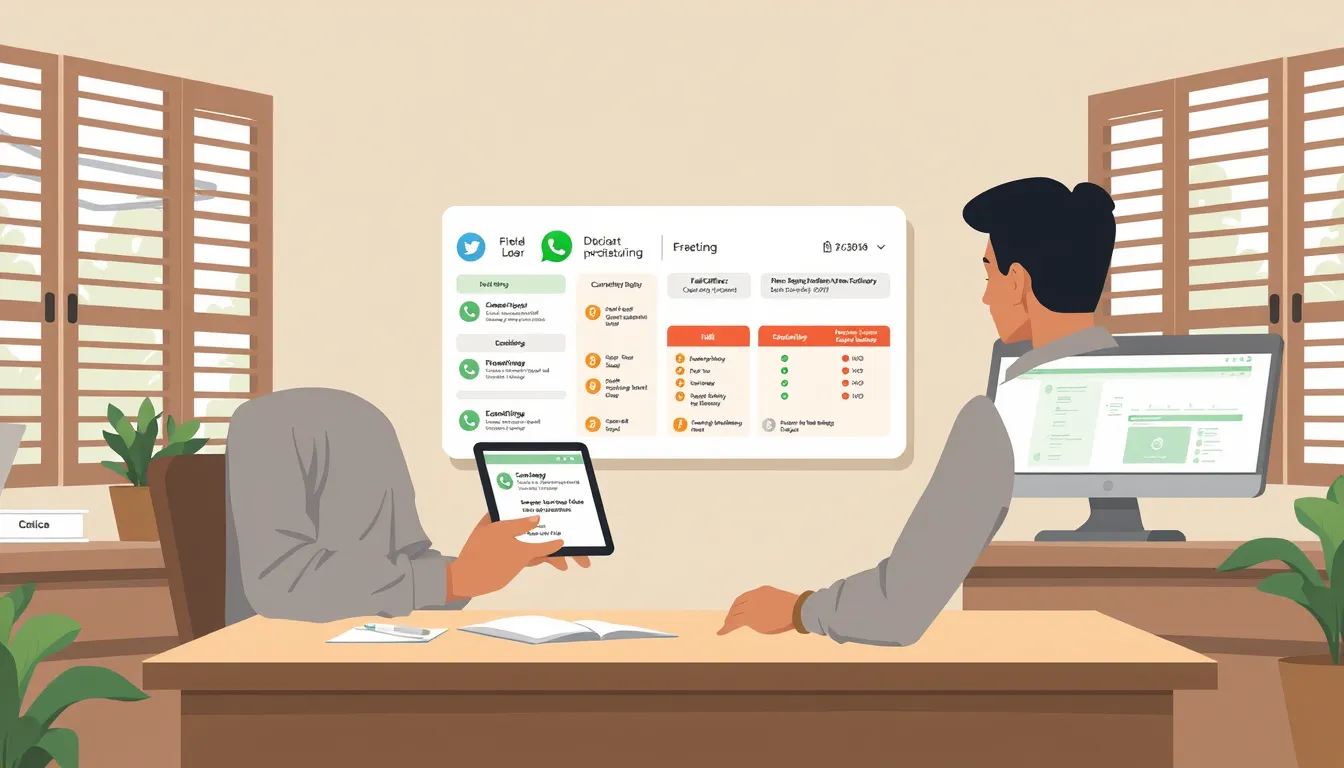
With an AI agent handling WhatsApp outreach for pre-overdue accounts:
- Messages go out on schedule, templated, translated into the borrower's preferred language or dialect register, and timed to avoid disrupting working hours.
- Responses are classified automatically — a borrower who replies with a payment confirmation is logged; one who signals difficulty is escalated to a human officer with full conversation context attached.
- Promise-to-pay commitments are tracked end-to-end, with a follow-up triggered if the commitment date passes without a payment record in the core system.
- Every interaction generates a tamper-evident audit trail that compliance teams and, where relevant, OJK supervisors can review.
This is not AI making collections decisions. This is AI handling the reliable, auditable communication scaffolding so that human field officers spend their time on the cases that actually require human judgement.
The Escalation Logic: Where Human-in-the-Loop Matters Most
For regulated institutions operating under OJK supervisory expectations and Indonesia's personal data protection law (UU PDP), the question is never simply whether AI works. It is whether AI can be shown to work within a governance framework that survives an audit.
Two design principles separate compliant AI arrears tools from risky ones.
Shadow mode before live deployment. Any AI agent handling borrower communications should be capable of running alongside existing processes — generating the messages it would send, logging the actions it would take — without actually sending anything. This gives compliance officers and collections heads the chance to review AI behaviour against internal policies and OJK-aligned standards before a single real borrower receives an AI-generated message. A tool that cannot run in shadow mode is a tool asking for institutional trust it has not yet earned.
Hard escalation gates. Certain conditions — a borrower expressing financial distress, a loan in a restructuring discussion, an account flagged for dispute — should immediately halt automated outreach and route to a named human owner. These gates are not optional features. They are the line between AI assistance and AI overreach, and they need to be configurable by the institution, not hardcoded by the vendor.
For a collections head, this means the AI is genuinely handling the routine volume: the pre-overdue nudges, the payment-due reminders, the post-due first-touch messages. The cases that land on a human desk are already pre-triaged — the AI has made the first contact, logged the response, and flagged the ones that need a person.
Arrears Triage: Structuring the Cascade
Not all overdue accounts deserve the same response intensity. A borrower who is two days late and has a strong payment history is a different conversation from one who is 30 days past due with prior restructuring. Effective AI-assisted arrears management respects that distinction rather than flattening it.
A workable cascade for a BPR might look like this:
| Days Past Due | AI Role | Human Role |
|---|---|---|
| 0–7 (pre-overdue) | Automated WhatsApp nudge, payment link or confirmation request | Review flagged non-responses |
| 1–15 DPD | Structured reminder sequence, response classification | Follow up on distress signals, escalate disputes |
| 16–30 DPD | Prompt to schedule call, collect promise-to-pay commitment | Conduct call, log outcome, confirm restructuring eligibility if applicable |
| 31+ DPD | Flag for field visit scheduling, cease AI-led outreach | Field officer engagement, formal collections process |
The AI does not own the 31+ DPD relationship. That relationship has moved beyond what structured communication can resolve, and pretending otherwise would damage borrower trust and expose the institution to regulatory risk.
What the AI does own — cleanly, consistently, at scale — is the early cascade. That is where the volume is. And it is where small delays in contact historically allow easy-to-recover accounts to drift into genuine non-performing loan (NPL) territory.
Data Minimisation and Audit-Grade Records
Borrower data in a rural bank context is sensitive in ways that urban fintech sometimes underestimates. A borrower's repayment difficulty in a small community has social consequences. AI systems handling that data need to apply data minimisation principles: collecting only what is necessary for the communication task, retaining it only as long as required, and ensuring that access logs exist for every record retrieval.
For OJK reporting and internal audit purposes, audit-grade records of every AI interaction — what was sent, when, what response was received, what action was triggered — are not optional. They are the institutional paper trail that demonstrates the bank's collections process was conducted lawfully and in accordance with its own policies.
If a vendor cannot show you that paper trail clearly, that is a meaningful red flag.
Tier-Tailored Reporting for the Collections Head
One underappreciated operational benefit of AI-assisted arrears management is what it does to management reporting. Collections heads at BPRs often spend significant time assembling a picture of the arrears portfolio from multiple sources — officer reports, core banking extracts, call logs — that are rarely in the same format or on the same timeline.
An AI layer that is properly integrated generates tier-tailored reporting as a byproduct: branch-level contact rates, promise-to-pay conversion rates by officer or portfolio segment, escalation volumes, and response time distributions. None of this requires additional data entry. It emerges from the interaction records the AI produces anyway.
That shift — from reporting as a manual assembly task to reporting as a live output of the operational process — changes how quickly a collections head can identify a deteriorating portfolio segment and respond before it becomes an NPL problem.
What Aureus Automation Offers
ResolveLink is Aureus Automation's AI-assisted collections and arrears resolution product, purpose-built for rural banks and multifinance institutions in Indonesia. It is currently in early access, with commercial launch planned for Q1 2027.
It is designed from the ground up around the operational constraints of BPRs: limited IT teams, mixed-literacy borrower populations, OJK-aligned by design, and built to run in shadow mode before any live deployment. The human-in-the-loop architecture is not a configuration option — it is the default.
For institutions that want to understand what AI for arrears management would look like in their specific operation — their branch structure, their portfolio mix, their existing core banking setup — the most useful next step is a direct conversation.
See what this looks like in your operation. Get in touch with the Aureus Automation team to explore whether ResolveLink fits your arrears management workflow.